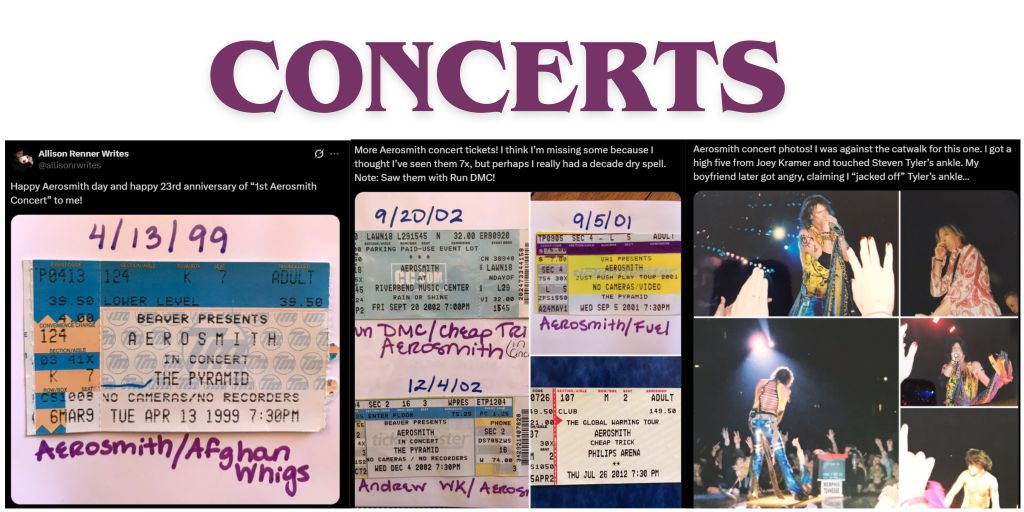
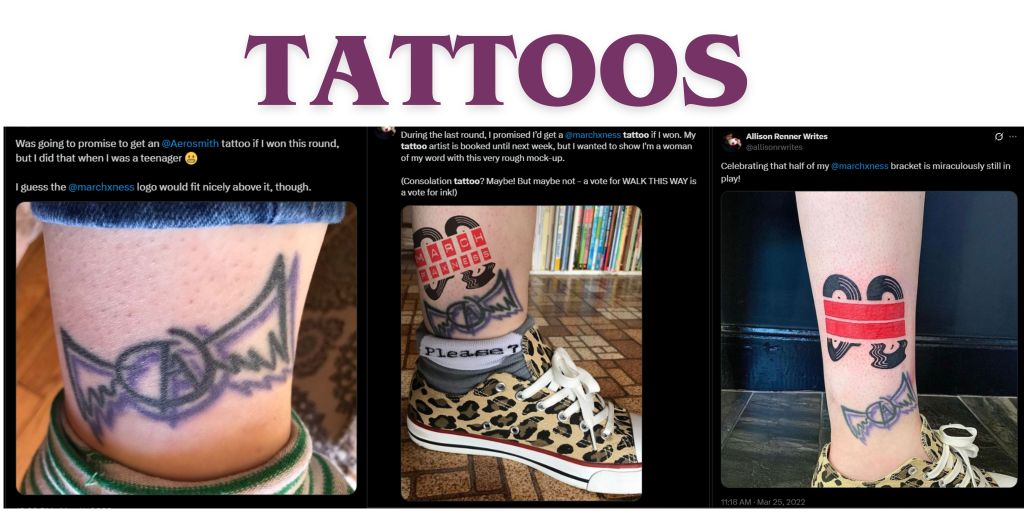
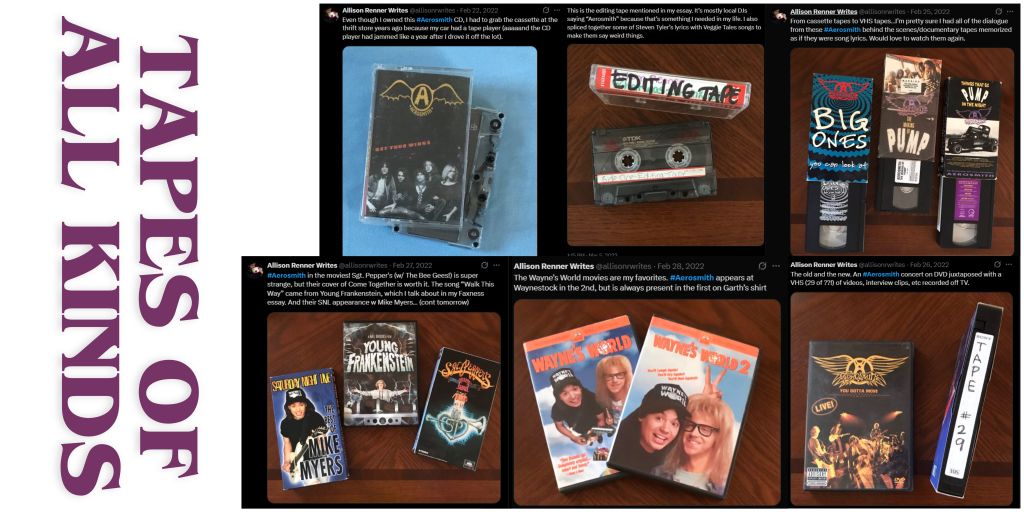
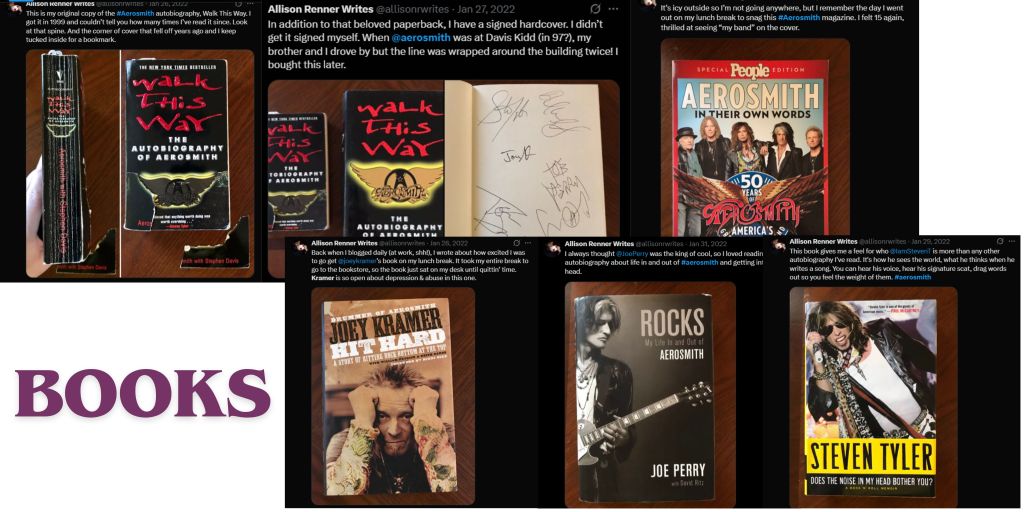
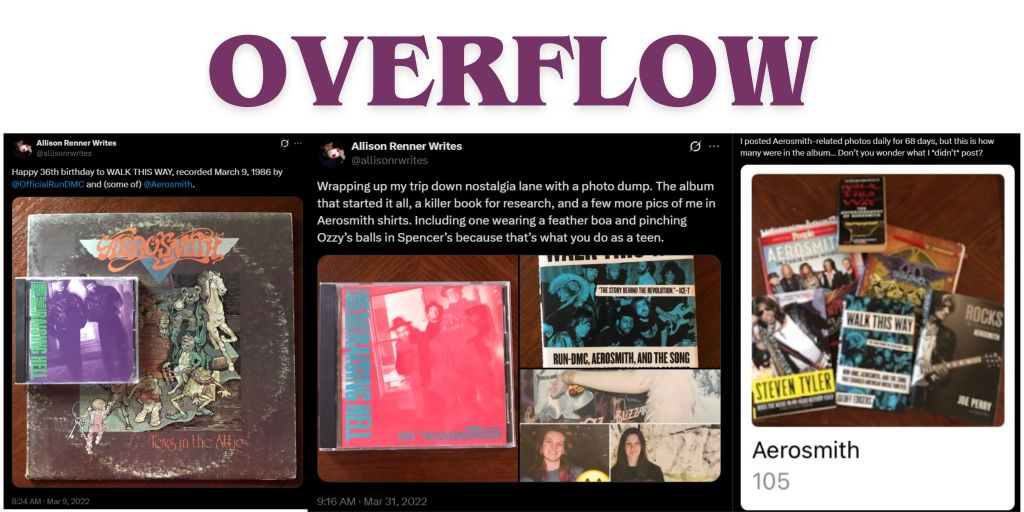
In March 2022, I competed in March Faxness. My essay, “The Song That Almost Didn’t Happen,” made it to the Sweet 16 and I’m very proud of it, but more than that, I’m proud of the (most likely incredibly annoying to everyone else) Twitter campaign I launched to share my memories and memorabilia that didn’t make it into the essay.
In the interest of not losing those to whatever may happen to Twitter/the internet at large, I screenshot all I could find and grouped them into nice little graphics for you to enjoy after you read my essay, or just because.
The Memorabilia






The Essay Itself
The Song That Almost Didn’t Happen: Allison Renner on “Walk This Way”
It seems strange to write an essay about a cover song done by the original artists. It’s even stranger to step up to bat for a song I didn’t like when I first heard it. But when I say I was a teenage Aerosmith diehard, I’m not exaggerating. I worshipped Aerosmith in their purest form, and other artists diluted this song.
Picture this: I had so many Aerosmith t-shirts that I could wear a different one every day for two weeks. And that’s excluding the one that featured a virtually-naked Joe Perry centaur and the one with the Toxic Twins skull and crossbones. The latter guaranteed I’d get pulled out of line to walk through the metal detectors at the entrance of my high school.
I bought singles, imports, and the Steven Tyler issue of Playgirl through eBay back when “buying online” meant mailing concealed cash and crossing your fingers that the other person cared about their seller feedback.
Despite owning every album, I listened to the classic rock stations and recorded the tail end of Aerosmith songs. I wanted to hear the DJ say “Aerosmith” because it gave me a thrill—that’s my band! I eventually utilized the dual cassettes of my stereo to record each mention of Aerosmith onto its own compilation tape. Because obsessing is what you do when you’re thirteen and in love for the first time.
*
I’d argue “Walk This Way” is as much of a cover as when Aerosmith performed the Beatles’ “Come Together” for Sgt. Pepper’s Lonely Hearts Club Band. In their autobiography, Walk This Way, there’s a story about Steven Tyler not recognizing “You See Me Crying,” a song from the same album as “Walk This Way.” Aerosmith was plotting their comeback in the early ‘80s, listening to old tracks when Steven said, “We should cover this. Who is it?”
“It’s us, fuckhead,” Joe Perry replied.
My theory is that, if Steven wanted to cover a song that was his own without knowing it was his own, it’s not far-fetched to posit that he might not have remembered “Walk This Way” was his just a few years later.
And it’s not like the lyrics are personal enough to be memorable. It was written when the band hit a roadblock in the Toys in the Attic recording process. They took a break and went to see Young Frankenstein. So delighted with the joke of Igor telling Dr. Frankenstein to “walk this way” using his cane, the band told Tyler to use the phrase as the song title and write the lyrics from there.
Despite being an Aerosmith devotee (I mean, I own the previously mentioned Sgt. Pepper’s Lonely Hearts Club Band on VHS), I didn’t see Young Frankenstein until I was in my twenties. When I rewatched it as “research” for this essay, I pictured a group of twenty-something boys, likely high, watching it in the theater. I imagined them fixating on this one line—was it really that funny?—and taking it home to put to music. That movie-going experience created one of the most recognizable rock songs, which eventually became crucial to bridging the divide between rock and rap.
*
Though “Walk This Way” was never my favorite Aerosmith song, I appreciated that I could turn on any classic rock station and have a 75% chance of hearing it. Despite being well-known, “Walk This Way” never topped the charts. But the cover came close.
Aerosmith recorded Toys in the Attic, their third album, at the end of 1974. “Walk This Way” was released as the album’s second single on August 28, 1975, and didn’t make the charts. “Sweet Emotion,” the album’s first single, was the band’s breakthrough Top 40 Hit and pushed them to re-release “Dream On,” a song from their debut album in 1973.
On November 5, 1976, Aerosmith re-released “Walk This Way,” which peaked at #10 on the Billboard charts. (Aerosmith never had a #1 single until “I Don’t Want to Miss a Thing” in 1998, which was written by an outside songwriter who had Celine Dion in mind so we’re going to back away from this little digression.)
Almost ten years later, on March 9, 1986, Run DMC, Steven Tyler, and Joe Perry got together to re-record “Walk This Way.” Call it a cover, call it a collaboration, call it coercion—it was released as a single against Run DMC’s wishes on July 4, 1986 and shot to #4 on the Billboard charts.
*
It’s not surprising that “Walk This Way” bridged the gap between rap and rock. A lot of Steven Tyler’s vocals are as clever, sly, and rapid-fire as rap lyrics. He uses his voice like percussion on countless songs.
“Eat the Rich” comes to mind, mostly because I chose to rap it as a final project for my freshman Social Studies class. No, I didn’t use it to make a commentary on social injustice or unfair taxation. I wrote lines about weather patterns to rap over the song.
To this day, I can’t explain why. It just felt right, the way things feel when you’re young and obsessed and want to inject this delightful part of your life into something mundane. I wanted everyone in that 6th-period class to know that I loved Aerosmith.
Except… I couldn’t stand the idea of rapping in front of my classmates. I was a mere freshman, a cripplingly shy one at that, and there were sophomores in there!
I decided to record myself the night before and bring in a portable tape player. But when I tried to rap alone in my room, my voice shook with nerves. It seemed like there was no solution, and no time to start and complete another project. I was going to fail.
My mother came to the rescue, volunteering my brother’s vocal cords. He had escaped the torture of high school and was safe in college. He recorded the rap without worrying what people would think of him.
That night, lying awake in bed, I felt good about my project. Bringing Aerosmith and rap together again, in a way no one would expect. I felt like a trailblazer—almost (aka not at all) as cool as Run DMC.
None of those good vibes were with me as I stood in class, listening to my brother rap:
Well I woke up this morning
On the wrong side of the bed
And how I got to thinkin’
About the rain on my head
About all the weather patterns
And how they make you sick…
I cannot express how awkward it was to stand there with my face burning, trying to ignore all the blank stares of my classmates. Thankfully, the combination of rap and rock by true professionals turned out much better, changing the scope of the music industry. But if you watch the MTV coverage of the actual recording, you’ll get a good sense of the awkwardness that seems to encompass the blending of these two genres.
The VJ is asking questions no one really knows the answers to—but they also know they can’t be honest. By now, both acts understand how huge this could be. So of course the guys on Run DMC’s team will exclaim that Aerosmith is their favorite band. Steven Tyler, on the other hand, will say “Yeah, we’ve heard ‘em,” when asked if he likes Run DMC’s music.
“I guess I called up Run…” Tyler says, though they all just admitted it was the first time they met. “He asked Joe and I to come down and do a cameo thing.”
There are several different versions of who contacted whom to make this thing happen, but it’s pretty obvious that Steven Tyler didn’t call up a rapper and suggest collaborating. And Run DMC wouldn’t have gotten in touch with Aerosmith, because they didn’t even know who was behind the song. All they knew was that they liked to rap over the first few seconds of “track 4, Toys in the Attic,” which could have been the band’s name, for all they cared.
Run DMC didn’t even want to cover the song. They were done recording Raising Hell when Rick Rubin mentioned it to them. They figured they’d use a sample and riff over the rest. But Rubin insisted the rappers learn the original lyrics, so they listened to the song over and over, transcribing the words by hand. Before they knew it, Steven Tyler and Joe Perry were in the studio, ready to record.
“Is this something that you might want to do again?” the VJ asks.
Run DMC answers as diplomatically as you would if someone you’re not into asks you on a second date. “We just trying to make this one work right now. We ain’t thinking about the future.”
Nowadays, DMC says he doesn’t think the song would have been as big if they just sampled it and wrote their own rap, or even if they covered it without Aerosmith. “Because we did it with them, changed everything,” he says. And you can’t argue with that.
*
I have five live versions of “Walk This Way” on my iPod. I know all the words, even when Steven Tyler yells “Get the fuck off of the fence!” over the drum beats on the one from A Little South of Sanity. Or “What are ya tryin’ to say?” as he holds the mic up to Joey Kramer’s drums on the bootleg copy of their New Year’s Eve 1999 performance in Osaka, Japan.
But I only have one version of “Walk This Way” with Run DMC—the studio version. And I don’t know all the lyrics, though I know Run DMC changed some because they deemed it “country bumpkin bullshit” and “hillbilly gibberish.” I don’t even have the Run DMC single of “Walk This Way,” where the B-side is an instrumental version with Steven Tyler randomly singing one chorus.
It feels weird to be a 30-something white woman, once a die-hard classic rock fan, now dipping her toes into ‘80s rap, but here I am. I’m defending a song I didn’t originally like. I didn’t understand its impact because, by the time I heard it, “radio rap” was mainstream. I was familiar with Juvenile, Nelly, and Sisqó. I could hear rap booming from the speakers of my high school classmates’ new Jeeps as I walked by the parking lot every morning. (I’d argue that they didn’t like rap either, but rather the counterculture it represented in our little bubble.)
Which is exactly who Russell Simmons was aiming to hook when he proposed Run DMC cover a rock song. He wanted to bring rap into the mainstream—and he did.
DMC has since gone on record saying this experience taught him to “always be open to try something new because it might not just change your life, it could change the world.”
Which is certainly a beautiful sentiment. But I keep picturing those 22-year-old rappers huddled in the corner, eating McDonald’s. They’re more interested in their Big Macs than the 30-something rock legends standing nearby. Thirteen-year-old me couldn’t believe their audacity, but now I’m older. I get it. They were pushed to do something they didn’t want to do, and they just wanted to eat their burgers. If that’s not a #mood, what is?
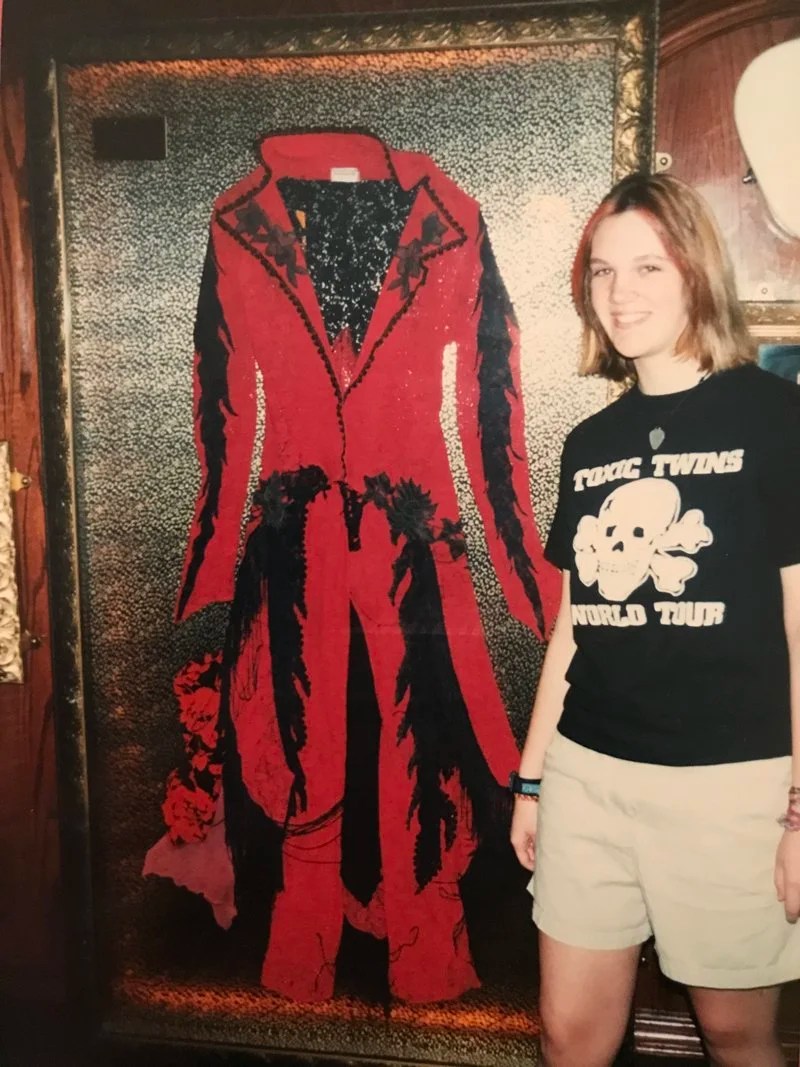
Allison Renner, pictured here with Steven Tyler’s outfit from the “Love in an Elevator” video, is an editor for Flash Fiction Magazine and the Publicity & Reviews Manager for Split/Lip Press. Her fiction has appeared in or is forthcoming from the Daily Drunk, Six Sentences, Rejection Letters and Versification. She can be found online at allisonrennerwrites.com and on Twitter @AllisonRWrites. And yes, she still owns the homemade cassette of local DJs saying “Aerosmith” over and over. Because why not.
 Allison Renner Writes